Once, when the world was young, we stopped somewhere in Wyoming (I believe it was: perhaps elsewhere) and hiked a short ways to see old ruts in the grass which were part of the Oregon Trail. It was easy to imagine wagon after wagon, time and again, following and creating those ruts, still there.
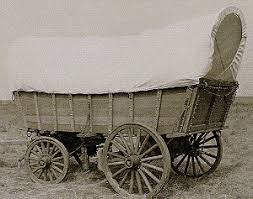
Sometimes "going west, young man" meant leaving from Independence, Missouri, and driving a team of horses or oxen pulling a conestoga wagon, or something, all the way to Oregon City, Oregon. Here and there, one can still see the tracks in the grass, as unplowed yet as they were then, neglected by every kind of subsequent machinery.
 Earlier this month, Daniel and Ellie drove Mari and me to Oregon City, where Daniel sometimes works, and where we had lunch. There is a monument to the terminus of the Oregon Trail, if monument it is to be called. It is supposed to be a Conestoga wagon train, but it looks like boxcars with great pipe hoops arching overhead, resting on the ground.
I think one really had to want to get out of Missouri to set out on a trail like that. It must have been something like children leaving Guatemala with a name or phone number pinned inside a seam, and going north, through Mexico. I wonder if I'd had the courage for either.
Probably not. Especially had I seen the monument before I left.
Sometimes "going west, young man" meant leaving from Independence, Missouri, and driving a team of horses or oxen pulling a conestoga wagon, or something, all the way to Oregon City, Oregon. Here and there, one can still see the tracks in the grass, as unplowed yet as they were then, neglected by every kind of subsequent machinery.
I think one really had to want to get out of Missouri to set out on a trail like that. It must have been something like children leaving Guatemala with a name or phone number pinned inside a seam, and going north, through Mexico. I wonder if I'd had the courage for either.
Probably not. Especially had I seen the monument before I left.
Comments
Post a Comment