". . . one of the risks. . . ."


Implode:  to collapse violently in upon itself.
In contrast to, exploding:  to burst violently, from internal pressure.
Perhaps, in a president, preferable to exploding: fewer fragments.

I think Mr. Trump will implode.

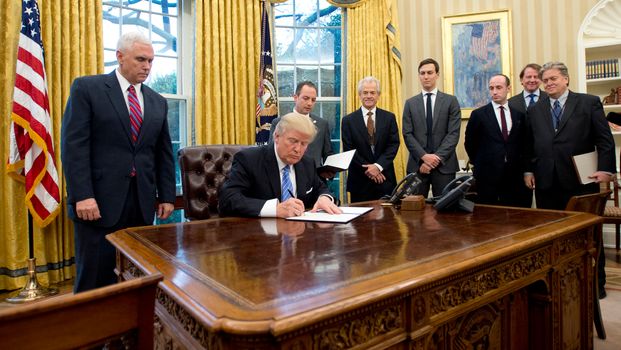
There he is, hard at work, early in his Presidency,
being presidential, signing a bill restricting
women's rights to choose, insofar as he can do it,
so far.  He is surrounded by Seven Deadly Witnesses,
all of whom appear to be male, but who knows,
these days?  I guess we can, in this case.

Was there ever anyone less prepared to be President?
There have been many who wanted it less,
who actually knew what the job entailed,
but we are a democracy, or a republic, and
as Adlai Stevenson II once said, "In America,
anybody can be president.  That's one of the risks you take."

And we like to say we are risk takers,
but we are not a monarchy or a mega-business:
we are a republic; a very large one,
and our President has a large and precarious job to do,
holding the Republic together, nudging it toward
a more perfect union.  I suspect that the inside of the White House
might be the best place to learn how much hard work it takes
to govern a democratic society.  It will make
scrounging up money from questionable foreign sources
and stiffing contractors and hotel and restaurant employees look easy.

I don't think Donald Trump is going to enjoy being President:
there is too much work to do, too many people who have to be heard
about everything that has to be done, too little actual power,
and not enough gold plating and obeisance.

I suspect he will implode.

Comments

Popular posts from this blog

Friends-- My step-father of 35 years died this morning. His name was Conrad Royksund. He was 86 years old. He was born into poverty on a farm near Puyallup, WA. He was the first member of his family to attend college and earned a PhD from the University of Chicago. He paid his way through all of that by fishing in Alaska. He spent his professional career as a college professor. I met him when I was just 3 years old and don't actually have any memories of my life befor e he was in it. He was intimidatingly smart, funny as hell, and worked his ass off. He taught me to meet people with kindness and decency until I was certain they could not be trusted. He taught me to meet ideas with carving knives until I was certain they could. I will remember him as one of the bravest, most curious, and funniest people I have ever met. He left this world with a satisfied mind. We are so grateful. Dan Hubbard

Nice to Run Into You Again

We do not see things in enormous time-frames.  We human beings are fairly new at figuring things out for ourselves.  For instance, some  people today still think of the earth as a newly created thing, perhaps ten thousand years old.  Earth is actually about four-and-a-half billion years old.   That is to say, the earth is 450,000 times older than the Adam and Eve story, and the universe is three times older than that! I recall first hearing that continents were slowly drifting around the earth, and that there quite likely had been several times when the continents were squeezed together.  But people could stand on the edge of their own continents, and not see Africa or Asia getting closer.  It took at least fifty years to figure things out. We called our continent something special. But sure enough, there have been numerous times during several-billion year history of the earth, when supercontinents formed, and eventually drifted off. ...

The Sea is Rising

Let us just step back:  two hundred and fifty years ago, or so, the ships of England and Spain had drifted onto a whole new continent, as they saw it, from far north to a savagely cold south; pole to pole, as if there were such things. Millions of people already lived here, some of them still hunters and gatherers; some of them very wealthy, indeed!  Gold and silver stolen from the southern Americas funded Spanish and English dreams. There was land, lots of land, under starry skies above, rich land, and oil and coal and iron ore.  The whole western world learned how to build industries not on simple muscle power, but on steam and oil.  We farmed, too, of course.  All we needed was cheap labor--slave labor from Africa, mostly, so the ships came with slave labor.  Chinese labor built railroad beds where there had been rock cliffs. Europeans, long used to killing each other for good, religious reasons, brought their religious savagery with them. ...